Faroe
[ˈfɛəroʊ]Faroe is short for the Faroe Islands, and the name is Old Norse: Færeyjar, from fær, "sheep", and eyjar, "islands". It means Sheep Islands, which is what the Norse settlers found worth naming.
Temperament
Related Names
Fronx
A portmanteau of "Frontier Next", a name trademarked by Suzuki in 2014
Innis
Recorded as a rare masculine given name in english
Tiree
Aliso
Apaco
Azera
The name Hyundai used for the Grandeur in markets such as North America and the Middle East
Balta
A given name recorded in Lithuanian (rare, feminine) and Serbian (masculine); also a surname
Bralu
Bravo
A surname, from Spanish or Italian bravo
Camen
A stage name of the Swiss singer Pascal Camenzind
Sheep islands
The islands' own name is Føroyar, and the English "Faroe" is a shortening of "Faroe Islands" taken from the same source. Both come from Old Norse Færeyjar: fær, sheep, and eyjar, islands. The Norse settlers who gave it that name arrived during the Viking Age, and they named the place after the thing that was going to matter there.
It is a plain name, and plainness is the point. A great many island names in the North Atlantic are descriptions — Iceland, Greenland, the Orkneys — and Faroe belongs to that habit. It means what it says.
A place that kept its own language
The Faroes are an autonomous territory within Denmark, and Faroese is a North Germanic language descended from Old West Norse, closely related to Icelandic and considerably less changed than most of its neighbours. Around fifty thousand people speak it. That is a small number for a language with its own literature, and it survived a long period in which Danish was the written and official tongue.
None of which matters for naming a dog, except as the reason the name has a distinctive sound rather than being a coinage. Faroe is a real place with a real name, and the word carries that with it.
The animal the islands were named after
The name is not decorative. The Norse who called these islands the Sheep Islands were describing the basis of the economy: wool was what the Faroes produced, and the sheep that produced it are still there. NordGen, the Nordic genetic resource centre, lists the Faroese sheep among the Nordic native breeds — a hardy animal kept in an open, nearly treeless landscape, and the reason the islands were worth settling at all.
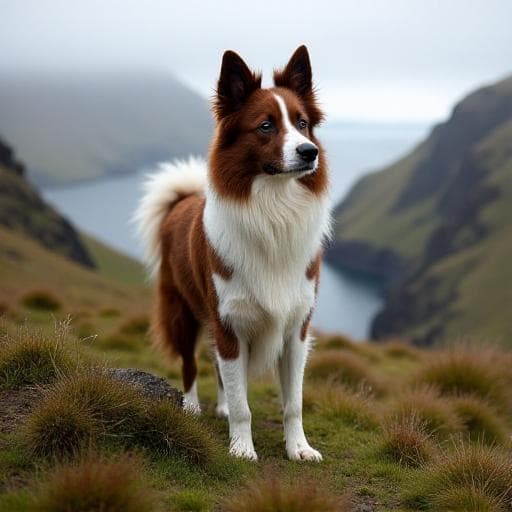
The place itself explains why. The Faroes are rugged, dominated by fjords and cliffs, with very few trees, and they sit far enough north that summer nights never fully darken while winter days are extremely short. Almost nothing grows there easily. The animals that could live on that ground were worth naming the country after, and that is exactly what happened.
The first Norse settler is named in the Færeyinga saga as Grímur Kamban, though the saga's chronology does not hold up — it has him fleeing a Norwegian king who was not yet born when the Norse reached the islands, which archaeology puts at some time after 825. There were people here before them: anchorites, religious recluses generally taken to have been Irish monks, who appear to have left when the Norse arrived.
Faroe as a dog name
FAIR-oh, or approximately so. The Faroese pronunciation is not far off, and the English one rounds it. Two syllables, opening on a fricative and ending on an open -o, which is a good closing vowel for a name you have to shout.
The name has an unusual quality among place names used for dogs: it is short, it is not a place most people have been to, and it does not announce a nationality the way Alaska or Kenya do. It reads as northern and slightly remote without being a cliché. If you want a name that sounds like somewhere but does not sound like a postcard, this is a better choice than most of the alternatives.
One practical note: Faroe is close to Fargo, which a certain generation will hear first and will mention. Whether that is a problem is a judgement about your tolerance for a repeated joke.
Common questions
What does Faroe mean?
"Sheep islands", from Old Norse Færeyjar — fær, sheep, and eyjar, islands. The Norse settlers of the Viking Age named the archipelago for the livestock that would sustain it.
Is Faroe a real name for a dog?
It is a place name being used as a name, which is a long-established habit rather than a traditional dog name. It is short, easy to call and unusual, which is what most people are looking for.
Sources
- Wikipedia: Faroe Islands (etymology)
- NordGen: the Faroese sheep
- Wikipedia: Faroese language
- Wikipedia: Grímur Kamban, the first Norse settler
- Wikipedia: Faroese sheep
Page reviewed .